The Math of Personal Loans: Interest Rates and Amortization
Taking out a personal loan for debt consolidation or a large purchase? Learn how personal loan interest is calculated and how to choose the right term length.
Calculate your exact monthly payments and total interest using our Personal Loan Calculator, or read on to understand the financial mechanics of unsecured debt.
Unlike a mortgage (which is secured by your house) or an auto loan (which is secured by your car), a personal loan is usually an "unsecured" loan. This means the bank lends you money based solely on your signature and your credit score, with no collateral to repossess if you default.
Because unsecured loans are riskier for banks, they carry higher interest rates than secured loans. Understanding the math behind personal loans is crucial to ensuring you don't overpay for the money you borrow.
How Personal Loan Interest Works
Virtually all standard personal loans are installment loans. This means you borrow a fixed lump sum of money, and you pay it back in fixed monthly installments over a set period of time (the term).
The payments are calculated using an amortization formula, ensuring that your payment is exactly the same every single month.
EMI = [P x R x (1+R)^N] / [(1+R)^N-1]
- P = Principal Loan Amount
- R = Monthly Interest Rate (APR / 12)
- N = Total number of months
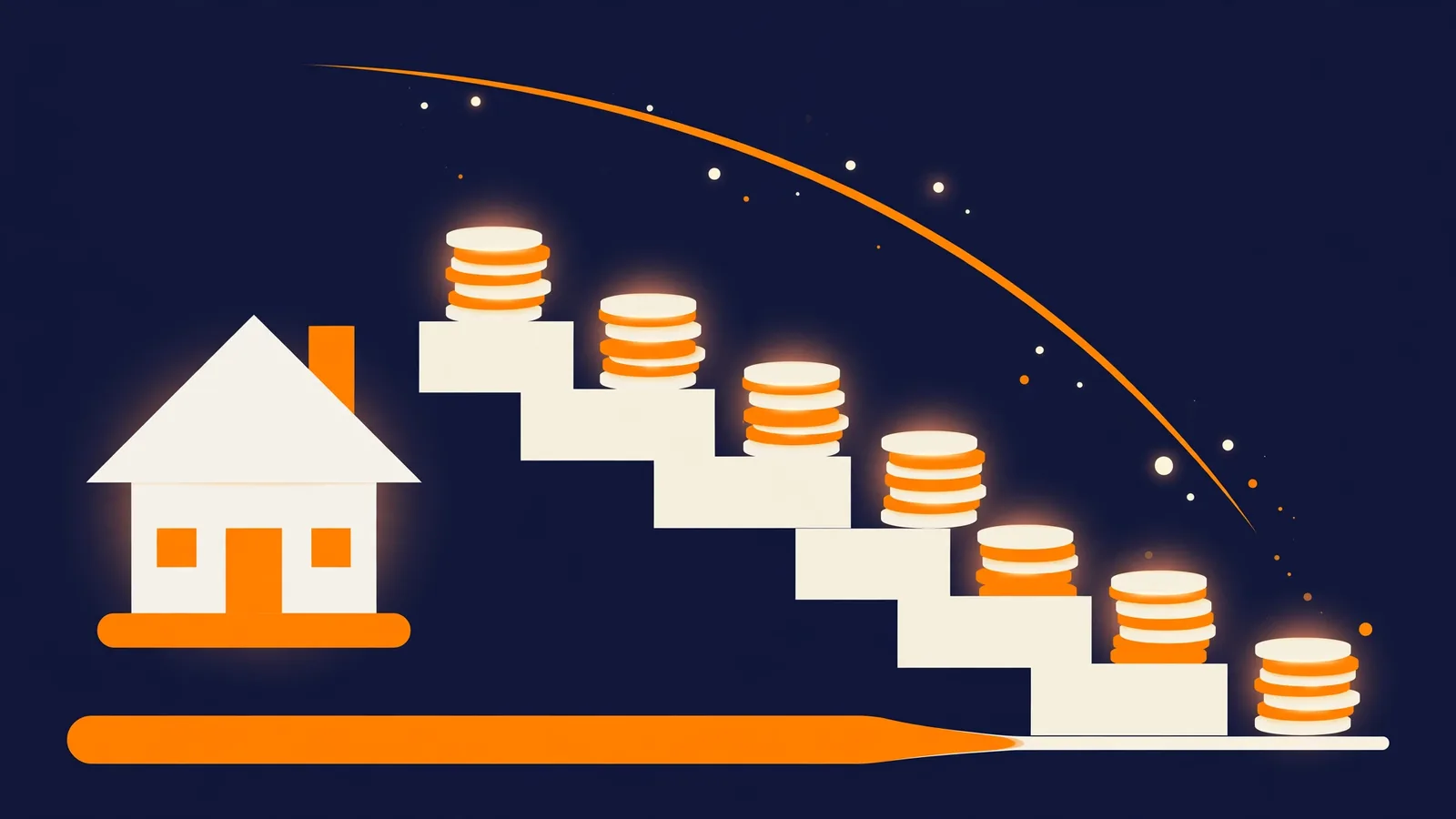
In the early months of your loan, a large portion of your fixed payment goes toward the interest. In the final months, almost the entire payment goes toward the principal.
Reading an Amortization Schedule
The split inside your payment changes every month, even though the payment itself never does. Take a $10,000 loan at 10% APR, with its fixed payment of $322.67.
Month 1:
- Interest:
$10,000 × (0.10 / 12) = $83.33 - Principal:
$322.67 − $83.33 = $239.34 - New balance:
$10,000 − $239.34 = $9,760.66
Because the balance fell, Month 2 charges slightly less interest, about $81.34. Slightly more of the payment attacks principal instead.
This snowball runs quietly for the whole term. By the final payment, interest takes only a few dollars of the $322.67, and principal takes nearly all of it.
Understanding this schedule matters for one practical reason: extra payments early in the loan are disproportionately powerful, as shown below.
Enter your own numbers and see the result instantly — free, no signup.
Term Length: The Ultimate Trade-off
When applying for a personal loan, the bank will often give you options for the term length (e.g., 36, 48, or 60 months). This creates a direct trade-off between your monthly cash flow and your total cost.
Example Scenario: A $10,000 Personal Loan at 10% APR
| Term Length | Monthly Payment | Total Interest Paid | Total Cost |
|---|---|---|---|
| 36 Months (3 Years) | $322.67 | $1,616.19 | $11,616.19 |
| 60 Months (5 Years) | $212.47 | $2,748.23 | $12,748.23 |
Choosing the 5-year term makes the loan feel more affordable by dropping your monthly payment by over $100. However, it costs you over $1,100 more in total interest because the bank is charging you for two extra years of borrowing time.
How to Choose the Right Term
Neither extreme is automatically right. Choose the term with your cash flow and total cost both in view.
- Pick the shorter term when your budget comfortably absorbs the higher payment. You pay less interest and exit debt sooner.
- Pick the longer term only when the shorter payment would genuinely strain monthly essentials. A loan you can sustain beats a cheaper loan you default on.
- Never pick by payment alone. Ask for the total interest figure at each term and compare those numbers directly.
Why It Is Not Simple Interest
A common misconception is that a 10% loan costs 10% of the original amount per year, every year. That would be simple interest: $10,000 × 0.10 × 3 = $3,000 over three years.
Amortized loans do not work that way. Interest is recalculated monthly on the current balance, and your payments shrink that balance constantly.
That is why the real total interest on the 36-month example is $1,616.19, not $3,000. The bank only ever charges you for money you still owe.
Our Simple Interest Calculator shows the flat method directly, which makes the contrast between the two systems easy to see.
Interest Rate vs. APR: A Subtle Difference
The interest rate is the cost of borrowing the principal. The APR is broader: it folds in the interest rate plus most upfront lender fees, expressed as a yearly rate.
Two loans can advertise the same interest rate and carry different APRs because their fees differ. That is why APR is the fairer comparison number between offers.
Our APR Calculator shows how fees translate into APR, so you can compare a low-rate, high-fee loan against a higher-rate, no-fee loan honestly.
How Extra Payments Change the Math
Because interest is charged on the remaining balance, every extra dollar of principal you pay early removes interest from every future month.
Stay with the $10,000 loan at 10% APR. On schedule at $322.67 a month, it ends in 36 months with $1,616.19 of interest.
Now pay a flat $400 a month instead — about $77 more:
- Payoff time falls from 36 months to 29 months.
- Total interest falls from $1,616 to about $1,260.
- You save roughly $356 and finish seven months early.
The earlier in the term you add the extra money, the harder it works. An extra payment in Month 2 shrinks the balance that all 34 remaining interest charges are calculated on.
Confirm your lender applies extra payments to principal and charges no prepayment penalty. Most reputable lenders do both, but the fine print decides.
Debt Consolidation Math
One of the most popular uses for a personal loan is debt consolidation—taking out one large loan to pay off several high-interest credit cards. But does the math actually make sense?
The Old Debt: You have $10,000 across three credit cards charging an average of 22% APR. If you make a fixed $300 payment every month, it will take you 52 months to pay them off, and you will pay $5,596 in total interest.
The New Loan: You take out a $10,000 personal loan at 12% APR for 36 months to pay off the cards immediately. Your new monthly payment is $332.14. You will pay off the debt in 36 months, and you will pay only $1,957 in total interest.
In this scenario, the personal loan saves you over $3,600 and gets you out of debt 16 months faster.
When Consolidation Fails
The math above assumes the credit cards stay at zero after the loan pays them off. That assumption is where consolidation usually collapses.
If you run the cards back up, you now hold the loan and fresh card balances. Total debt has grown, not shrunk, and the loan's fixed payment still arrives monthly.
Consolidation is a rate-and-structure tool, not a spending fix. Pair it with closing or freezing the paid-off cards if temptation is a real risk.
Common Mistakes to Avoid
- Comparing loans by monthly payment. Lenders can lower any payment by stretching the term. Compare total interest and APR.
- Ignoring origination fees. A fee deducted from your payout means you receive less cash than the loan amount, while owing interest on the full amount.
- Extending the term to fit a purchase. If the item only fits your budget at 60 months, the honest conclusion may be that it does not fit yet.
- Missing the prepayment clause. An early-payoff penalty can erase the entire benefit of extra payments.
- Consolidating, then re-spending. The single most expensive mistake on this list, as the section above explains.
FAQ
What is an Origination Fee? Many personal lenders charge an origination fee (typically 1% to 8% of the loan amount) simply for processing the loan. This fee is usually deducted directly from your loan payout.
If you are approved for a $10,000 loan with a 5% origination fee, the bank will only deposit $9,500 into your account, but you still owe $10,000.
Are there pre-payment penalties on personal loans? Legally, most reputable online lenders and credit unions no longer charge pre-payment penalties. Always check the fine print to ensure you can pay off the loan early without a fee to save on interest.
What matters more: the rate or the term? Both feed the same total. A high rate on a short term can cost less than a moderate rate on a long term, because interest is charged per month on the balance. Compare offers by total interest paid, which captures both at once.
Is a personal loan's rate fixed or variable? Most personal loans carry a fixed rate, so the payment never changes. Variable-rate personal loans exist but are less common; with those, the payment or the payoff date can move when market rates move. Know which type you are signing.
How much can I borrow with a personal loan? Lenders commonly advertise amounts from a few thousand dollars up to $100,000, but your approved amount depends on income, credit history, and existing debts. Borrow what the project requires, not the maximum offered — every extra dollar accrues interest from day one.
Model different loan amounts, APRs, and term lengths instantly with the CalcUnit Personal Loan Calculator.