Amortization Explained: How Loans are Paid Off Over Time
Why do the first 5 years of your mortgage feel like you are making no progress? Learn how amortization schedules work and how banks front-load interest payments.
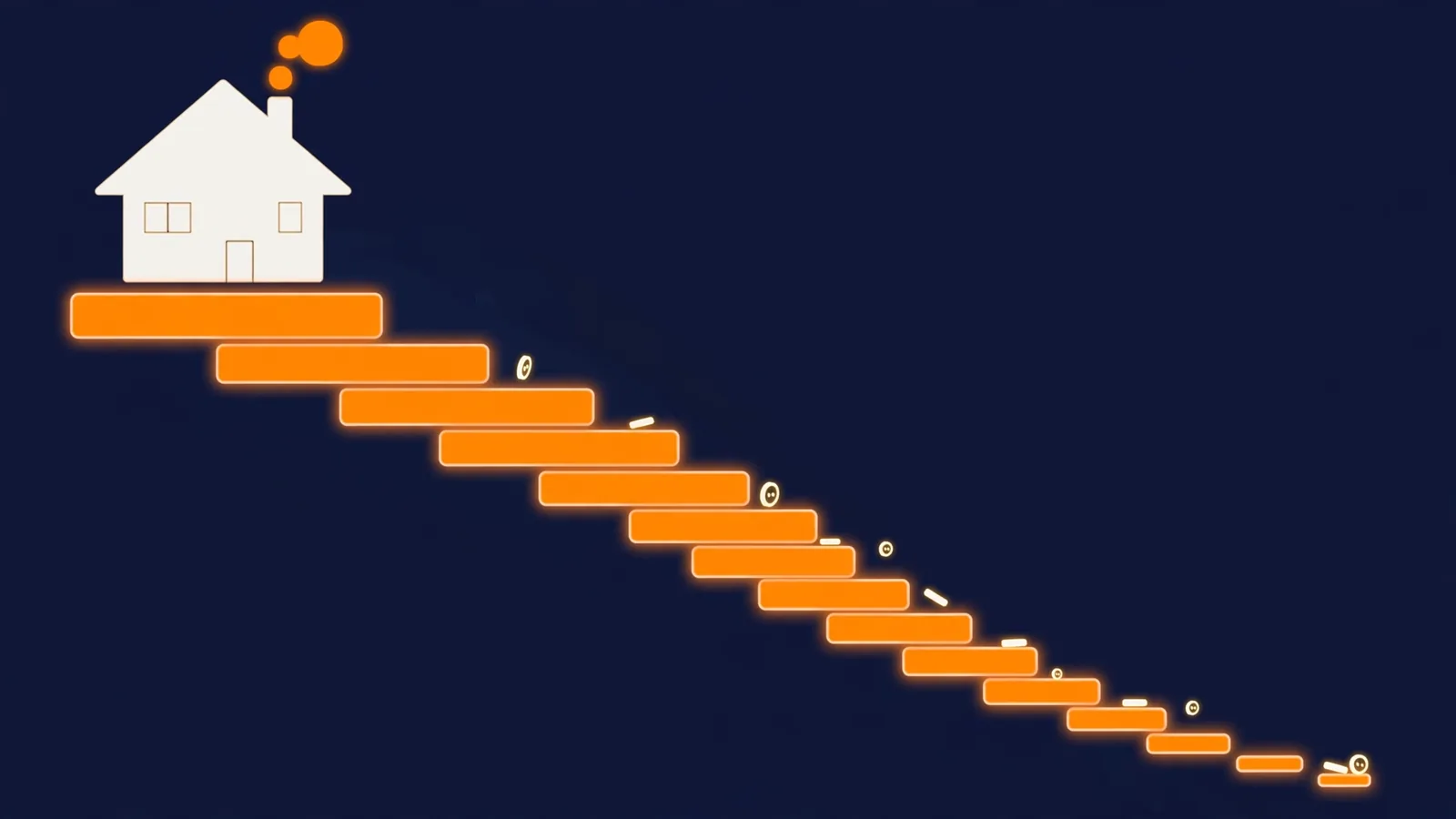
Generate a complete month-by-month breakdown of your debt using our Amortization Calculator, or read on to understand the complex mechanics of how banks structure debt repayment.
When you take out a 30-year mortgage or a 5-year auto loan, your monthly payment is identical every single month for the entire life of the loan.
However, what that payment is actually paying for changes drastically every 30 days. This mathematical process of gradually paying off a debt through fixed, regular payments is called Amortization.
The Two Parts of an Amortized Payment
Every time you make a payment on an amortized loan, the money is split into two buckets:
- Interest: The fee you pay the bank for borrowing the money.
- Principal: The actual money used to reduce the original amount you borrowed.
In an amortized loan, the bank calculates your interest strictly based on your current outstanding principal balance.
Other Parts That May Ride Along
Your total monthly housing payment may include more than principal and interest.
Many mortgages also collect property taxes and homeowners insurance into an escrow account.
Those escrow amounts are not part of the amortization calculation itself.
When you read a schedule, check whether it shows only principal and interest, or the full payment.
Enter your own numbers and see the result instantly — free, no signup.
How the Monthly Payment Is Calculated
Lenders set the fixed payment with a standard formula before the loan begins.
Payment = P × r × (1 + r)^n ÷ ((1 + r)^n − 1)
Where:
- P = Original principal, the amount borrowed
- r = Monthly interest rate, meaning the annual rate divided by 12
- n = Total number of monthly payments
For a $300,000 loan at 6% over 30 years, r is 0.005 and n is 360.
The formula gives a payment of $1,798.65 per month, before taxes and insurance.
That payment is chosen so the balance reaches exactly zero at payment 360, if every payment is made on time.
Try different rates and terms in the mortgage calculator.
Why Amortization "Front-Loads" Interest
The most frustrating part of a mortgage is looking at your statement after 5 years of payments and realizing you have barely reduced your actual debt. Many people falsely believe the bank "front-loads" the interest as a scam.
It is not a scam; it is just pure mathematics.
Month 1 Example:
You borrow $300,000 at 6% annual interest for 30 years. Your fixed payment is $1,798.
In Month 1, your principal balance is the full $300,000.
The bank calculates 1 month of interest on $300,000: $300,000 × (0.06 / 12) = $1,500.
- The bank takes $1,500 for Interest.
- The remaining $298 goes toward Principal.
Your new loan balance is $299,702.
Month 2 Example:
Your fixed payment is still $1,798.
But this month, the bank calculates interest on the new, slightly smaller balance of $299,702.
$299,702 × (0.06 / 12) = $1,498.51.
- The bank takes $1,498.51 for Interest.
- The remaining $299.49 goes toward Principal.
Because the Principal balance was slightly smaller, the Interest charge was slightly smaller, which left a few extra pennies to go toward the Principal.
The First Six Months, With the Exact Payment
Rounded figures explain the idea. A real schedule uses the exact payment of $1,798.65.
Here is the same illustrative $300,000 loan at 6%, month by month:
| Month | Interest | Principal | Remaining balance |
|---|---|---|---|
| 1 | $1,500.00 | $298.65 | $299,701.35 |
| 2 | $1,498.51 | $300.14 | $299,401.20 |
| 3 | $1,497.01 | $301.65 | $299,099.56 |
| 4 | $1,495.50 | $303.15 | $298,796.40 |
| 5 | $1,493.98 | $304.67 | $298,491.73 |
| 6 | $1,492.46 | $306.19 | $298,185.54 |
Notice the pattern: interest falls slowly, principal rises slowly, and the payment never changes.
Each month's improvement is small, but the direction never reverses.
What a Full Schedule Shows Over Time
An amortization schedule is the full table of every payment until the loan ends.
It usually shows the payment date, payment amount, interest, principal, and remaining balance.
Balance Milestones for the Example Mortgage
For the illustrative $300,000 loan at 6% over 30 years:
| After | Balance remaining |
|---|---|
| 1 year | $296,315.96 |
| 5 years | $279,163.07 |
| 10 years | $251,057.17 |
| 15 years | $213,146.53 |
| 20 years | $162,010.76 |
| 25 years | $93,036.26 |
Halfway through the term, at 15 years, more than two-thirds of the original debt is still owed.
The balance falls much faster in the second half than in the first half.
The First Year and the First Five Years in Totals
In year 1 of this example, you pay $21,583.82 in total.
Of that, $17,899.78 is interest and only $3,684.04 is principal.
Across the first 5 years, you pay $107,919.09 in total.
Of that, $87,082.16 is interest and $20,836.93 is principal.
These totals explain why early statements can feel discouraging, even though the loan is on track.
Generate your own year-by-year totals with the loan amortization calculator.
The Tipping Point
This slow, agonizing shift continues every single month for 30 years.
For the first half of a 30-year mortgage, the vast majority of your payment goes to the bank as interest. It isn't until roughly Year 18 (the Tipping Point) that the math finally crosses over, and more than 50% of your monthly payment starts going toward the Principal.
By Year 29, almost your entire $1,798 payment is going toward the Principal, with only a few dollars going toward interest.
Finding the Tipping Point Precisely
For the example loan above, the principal portion first exceeds the interest portion at payment 223.
That falls a little past the 18-year mark, which is why the tipping point is often described as occurring around year 18 to 19.
Your own tipping point moves with your rate and term.
Higher rates push it later. Shorter terms pull it much earlier.
On a 15-year loan, principal dominates the payment far sooner.
Amortization on Shorter Loans
Not every amortized loan feels as slow as a 30-year mortgage.
Shorter terms start with a much healthier principal share.
Auto Loan Example
Consider an illustrative $30,000 auto loan at 7% for 5 years.
The monthly payment is $594.04.
- Month 1: $175.00 interest, $419.04 principal, balance $29,580.96.
- Month 2: $172.56 interest, $421.48 principal, balance $29,159.48.
- Total interest over all 60 payments: $5,642.16.
Principal already beats interest in the very first payment here.
Model a car purchase with the auto loan calculator.
Personal Loan Example
Consider an illustrative $20,000 personal loan at 9% for 3 years.
The monthly payment is $635.99, and total interest is $2,895.81.
In month 1, $150.00 goes to interest and $485.99 goes to principal.
Short terms cost far less interest overall, but demand a higher monthly payment.
15-Year vs. 30-Year Mortgage: The Trade-Off
Term length is one of the biggest levers in an amortization schedule.
For the same illustrative $300,000 at 6%:
| Term | Monthly payment | Total interest |
|---|---|---|
| 30 years | $1,798.65 | $347,514.57 |
| 15 years | $2,531.57 | $155,682.69 |
The 15-year loan costs $732.92 more per month in this example.
It also saves $191,831.88 in total interest compared with the 30-year loan.
Neither choice is right for everyone. Cash flow matters as much as total cost.
A common middle path is a 30-year loan with voluntary extra principal payments.
The Power of Extra Principal Payments
Because of the way amortization works, making extra payments early in the loan has a massive, compounding effect.
If you add an extra $100 to your very first mortgage payment, that $100 bypasses the interest calculation entirely and instantly reduces your Principal. This means the bank can never charge you interest on that $100 for the next 30 years.
By consistently making small extra principal payments, you accelerate the "Tipping Point" and can easily shave 5 to 10 years off a 30-year mortgage, saving tens of thousands of dollars.
What Extra Payments Are Worth, in Numbers
Using the illustrative $300,000 loan at 6%, with extra principal paid every month:
| Extra per month | Loan paid off in | Interest saved |
|---|---|---|
| $0 | 360 months | $0 |
| $100 | 313 months | $53,346.41 |
| $200 | 279 months | $91,173.44 |
An extra $100 a month ends this loan 47 months early, in this example.
An extra $200 a month ends it 81 months early.
A one-time extra also helps. An illustrative $5,000 extra principal payment in month 12 shortens this loan to 345 months.
That single payment saves about $22,368.24 in interest over the life of the loan.
Rules for Making Extra Payments Count
Extra payments only work as intended if the lender applies them correctly.
- Mark extra money clearly as "apply to principal."
- Check your next statement to confirm the balance fell by the extra amount.
- Confirm your loan has no prepayment penalty before paying large extras.
- Keep an emergency fund first, instead of sending every spare dollar to the loan.
You can plan an accelerated payoff with the debt payoff calculator.
Common Mistakes and Misunderstandings
Watch for these frequent errors when reading a schedule:
- Believing the bank charges all the interest upfront. It does not; interest follows the current balance.
- Assuming equal payments mean equal principal each month. They do not.
- Forgetting that refinancing restarts the schedule from the slow, interest-heavy beginning.
- Making extra payments without telling the lender to apply them to principal.
- Judging a loan only by its monthly payment, ignoring total interest.
Refinancing deserves special care. A lower rate can still help, but the clock resets.
Compare the new schedule's total cost against keeping your current loan.
How to Read Your Own Schedule
Ask your lender for the full schedule, or generate one before you borrow.
Then check these four things:
- The payment amount, and whether it includes taxes and insurance.
- The month where principal first exceeds interest.
- The total interest paid over the full term.
- The balance at the date you realistically expect to sell or refinance.
If you expect to move in 7 years, the balance at year 7 matters more than the year-30 total.
That single insight can change which loan offer is actually best for you.
FAQ
What is a Negative Amortization Loan? Negative amortization occurs when your monthly payment is legally set so low that it doesn't even cover the interest charged that month. The unpaid interest is then added to your principal.
Instead of paying down your debt, your loan balance actually grows every month! These loans were a major cause of the 2008 housing crash.
Does amortization apply to credit cards? Not in the same fixed way. Credit cards have no set payoff term or fixed payment schedule. Your minimum payment is usually a small percentage of the balance, so the payoff timeline changes every month. A fixed-term installment loan, by contrast, follows a set amortization schedule.
Why is my first payment mostly interest? Because interest is charged on the full starting balance, which is the largest balance you will ever have on that loan. As the balance falls, the interest charge falls with it, and more of the fixed payment reaches principal. The first payment is interest-heavy by arithmetic, not by a special bank rule.
Can I change my amortization schedule? Yes, in several ways. Extra principal payments compress the schedule. Refinancing replaces it with a new one. Loan modification can also change the term or rate. Each option has costs or conditions, so compare the new total interest and fees before you switch.
Find your exact Tipping Point and see how extra payments change your timeline using the CalcUnit Amortization Calculator.