How to Add, Subtract, Multiply, and Divide Fractions: The Complete Guide
Struggling with fractions? We break down the mathematical rules for finding common denominators, multiplying straight across, and the 'keep-change-flip' division trick.
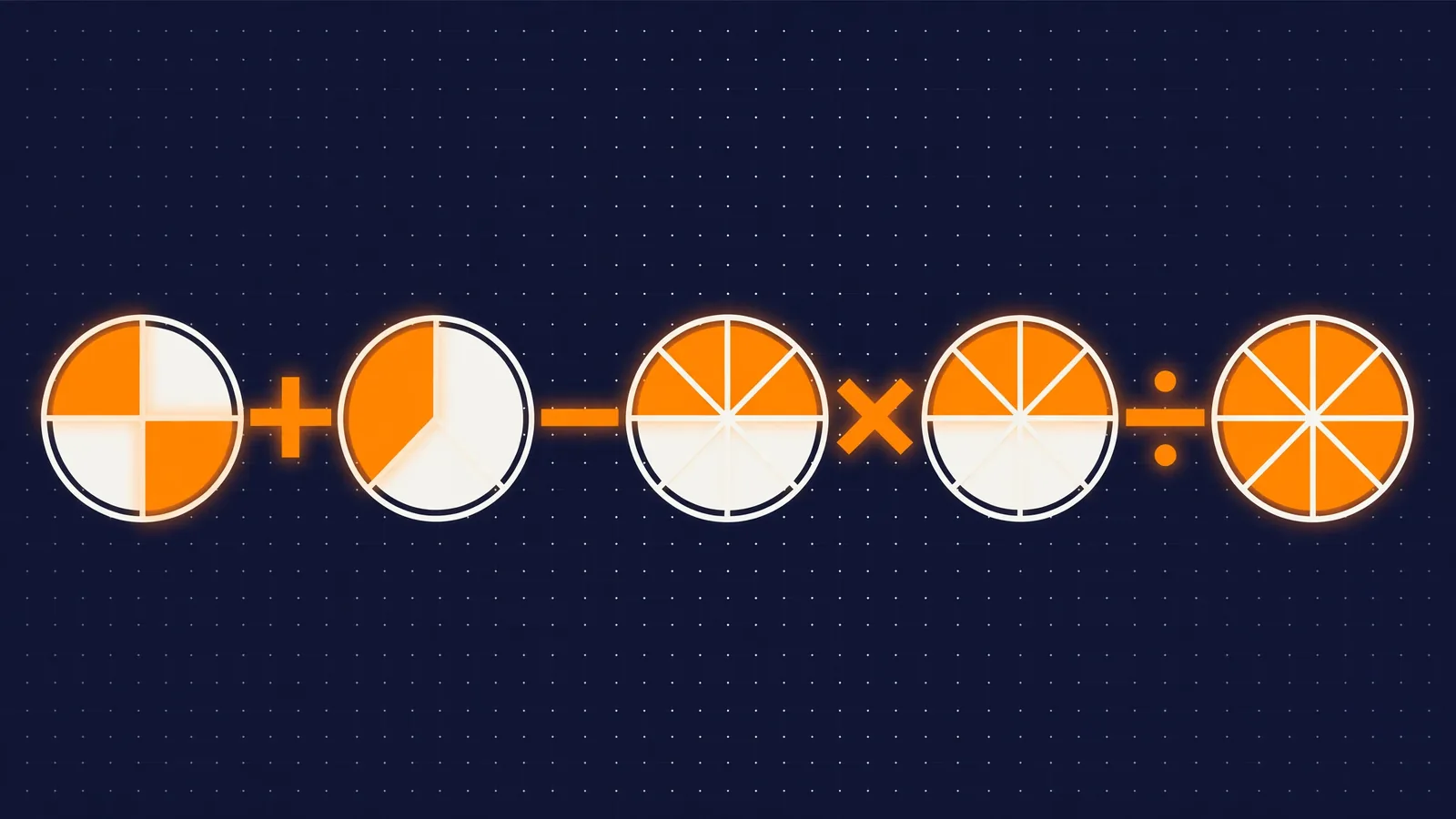
Solve complex fraction equations instantly, complete with step-by-step simplification, using our Fractions Calculator, or read our guide below to master the manual methods.
Fractions represent a part of a whole. Every fraction consists of two numbers:
- Numerator (Top Number): Represents how many parts you have.
- Denominator (Bottom Number): Represents how many total parts make up the whole.
While decimals are often easier to work with, fractions are strictly required in many fields like carpentry, cooking, and higher-level algebra because they represent exact values (e.g., 1/3 is exact, while 0.333... is an approximation).
The four operations do not play by the same rules, and that is where most confusion starts. Addition demands matching denominators, multiplication ignores denominators entirely, and division flips one fraction upside down. This guide treats each operation separately, then shows how they combine in real problems.
Adding and Subtracting Fractions
To add or subtract fractions, you must have a Common Denominator (the bottom numbers must be the same). You cannot add apples and oranges; similarly, you cannot add halves and thirds directly.
Step 1: Find a Common Denominator
Example: 1/2 + 1/3
The lowest common multiple of 2 and 3 is 6.
Step 2: Convert the Fractions Multiply the top and bottom of each fraction to reach the denominator of 6.
1/2becomes(1*3)/(2*3) = 3/61/3becomes(1*2)/(3*2) = 2/6
Step 3: Add the Numerators Now that the bottoms match, simply add the tops together. Do not add the bottoms.
3/6 + 2/6 = 5/6
(The exact same rules apply for subtraction).
Why does the denominator stay fixed? Because it names the size of the pieces, not a count of them. Three slices of a six-slice pizza plus two more slices is five slices — the pizza was never cut into twelve.
Any common denominator works, but the lowest one keeps numbers small. Our LCM Calculator finds the lowest common multiple of two denominators instantly when they get large.
Subtracting Fractions: A Worked Example
Example: 5/6 - 1/4. The lowest common denominator of 6 and 4 is 12.
- Convert:
5/6 = 10/12and1/4 = 3/12 - Subtract the numerators:
10/12 - 3/12 = 7/12 - 7 and 12 share no common factor, so 7/12 is already simplified.
If the first fraction is smaller than the second in a subtraction, the answer is negative. 1/4 - 5/6 = 3/12 - 10/12 = -7/12. The method does not change; only the sign does.
Adding Three or More Fractions
The same method scales. For 1/2 + 1/3 + 1/4, the lowest common denominator is 12.
- Convert all three:
6/12 + 4/12 + 3/12 - Add:
13/12 - As a mixed number: 1 1/12
Answers greater than 1 are normal and nothing to fear. Convert them to mixed numbers at the end if the context — a recipe, a measurement — reads more naturally that way.
Enter your own numbers and see the result instantly — free, no signup.
Multiplying Fractions
Multiplying fractions is actually much easier than adding them because you do not need a common denominator!
Rule: Multiply straight across. Multiply the numerators together, then multiply the denominators together.
Example: 3/4 × 2/5
- Top: 3 × 2 = 6
- Bottom: 4 × 5 = 20
- Result: 6/20
Always remember to simplify your final answer. Both 6 and 20 can be divided by 2, so the final simplified answer is 3/10.
Intuition check: multiplying by a fraction means taking a part of something. Three quarters of two fifths should be smaller than either starting value, and 3/10 is indeed smaller than both 3/4 and 2/5.
Multiplying a fraction by a whole number works the same way — just write the whole number over 1. So 4 × 2/3 = 8/3 = 2 2/3.
Cross-Cancelling: Simplify Before You Multiply
Professionals simplify before multiplying, canceling any numerator against any denominator that shares a factor. The numbers stay small and the arithmetic stays friendly.
Example: 4/9 × 3/8
- Cancel 4 (top left) with 8 (bottom right): divide both by 4 →
1/9 × 3/2 - Cancel 3 (top right) with 9 (bottom left): divide both by 3 →
1/3 × 1/2 - Multiply: 1/6
Verify directly if you like: 4 × 3 = 12 and 9 × 8 = 72, and 12/72 simplifies to 1/6. Same destination — cross-cancelling just takes the scenic route with smaller luggage.
Dividing Fractions (Keep-Change-Flip)
Dividing fractions uses a famous mental shortcut known as "Keep-Change-Flip."
- Keep the first fraction exactly as it is.
- Change the division sign (÷) to a multiplication sign (×).
- Flip the second fraction upside down (this is called finding the reciprocal).
Example: 1/2 ÷ 3/4
- Keep:
1/2 - Change:
× - Flip:
4/3 - New Equation:
1/2 × 4/3
Now, just follow the multiplication rule (multiply straight across):
(1 × 4) / (2 × 3) = 4/6- Simplified result: 2/3
Why does flipping work? Division asks "how many of these fit into that?" How many 3/4-cup servings fit in 1/2 a cup of flour is awkward; flipping converts it into a multiplication whose answer — 2/3 of a serving — makes sense.
A bigger sanity anchor: 5/8 ÷ 1/4 asks how many quarter-cups fit in 5/8 of a cup. Keep-change-flip gives 5/8 × 4/1 = 20/8 = 2 1/2. Two full quarters plus a half — exactly right.
Working With Mixed Numbers
Mixed numbers must become improper fractions before you multiply or divide. Addition and subtraction can be done either way, but converting first is the error-proof habit.
Multiplication example: 2 1/3 × 1 1/2
- Convert:
7/3 × 3/2 - Cross-cancel the 3s:
7/1 × 1/2 - Result:
7/2 = 3 1/2
Addition example: 1 3/4 + 2 1/2
- Convert:
7/4 + 5/2 - Common denominator 4:
7/4 + 10/4 = 17/4 - Back to a mixed number: 4 1/4
The conversion rule from the FAQ below (multiply whole × denominator, add numerator) is the only extra step. Every operation after that is one you already know.
Comparing Fractions
Which is larger, 3/5 or 5/8? Cross-multiplication answers without any conversion: multiply each numerator by the other denominator.
- 3 × 8 = 24 (this belongs to 3/5)
- 5 × 5 = 25 (this belongs to 5/8)
Since 25 > 24, 5/8 is larger — barely. A second method is the benchmark trick: both fractions sit near 1/2, and comparing each against one half (3/5 is 0.1 above; 5/8 is 0.125 above) gives the same verdict.
Fractions in the Kitchen and Workshop
Scaling a recipe is pure multiplication. A cake calling for 2/3 cup of sugar, scaled up by half again (× 3/2), needs 2/3 × 3/2 = 6/6 = 1 cup exactly. Fraction fluency turns recipe math into a non-event.
Reading a tape measure is addition in sixteenths. A board of 3/4 inch joined to one of 5/16 inch spans 12/16 + 5/16 = 17/16 = 1 1/16 inches — the kind of sum carpenters do without blinking.
Time is fractional too. Twenty minutes is 1/3 of an hour, and a 45-minute task is 3/4 of one. Converting schedules into fractions of an hour is how freelancers bill partial hours accurately.
Common Mistakes to Avoid
Adding the denominators. 1/2 + 1/3 is not 2/5. Quick proof it cannot be: 2/5 = 0.4, which is less than 1/2 alone. An answer smaller than one of its ingredients is automatically wrong.
Flipping the wrong fraction in division. Only the second fraction (the divisor) flips. Flipping the first one in 1/2 ÷ 3/4 produces 8/3 instead of 2/3 — a wildly different answer.
Skipping the final simplification. 6/20 and 3/10 are equal, but the unsimplified form is marked wrong on tests and misread in workshops. Finish every problem by dividing out the greatest common factor — our GCD Calculator finds it for stubborn pairs.
Multiplying mixed numbers directly. 2 1/3 × 1 1/2 is not 2 1/6. Whole parts and fraction parts do not multiply separately; convert to improper fractions first, every time.
FAQ
What is an Improper Fraction?
An improper fraction is a fraction where the numerator is greater than or equal to the denominator (e.g., 5/4). This means the value is greater than 1.
How do I convert a Mixed Number to an Improper Fraction?
A mixed number consists of a whole number and a fraction (e.g., 1 3/4). To convert it:
- Multiply the whole number by the denominator (
1 × 4 = 4). - Add the numerator to that result (
4 + 3 = 7). - Place that new number over the original denominator: 7/4.
What is the "butterfly method" I see in videos? It is cross-multiplication applied to addition: for a/b + c/d, compute (a×d + b×c) / (b×d). For 1/2 + 1/3 that gives (3 + 2) / 6 = 5/6. It always works, though it sometimes skips the lowest denominator, so simplify at the end.
How do I simplify 12/18? Find the greatest common divisor of 12 and 18, which is 6. Divide both parts by 6 to get 2/3. If no common divisor exists besides 1, the fraction is already in lowest terms.
For complex homework problems or workshop calculations, let our CalcUnit Fractions Calculator handle the common denominators and simplifications for you.