Fahrenheit vs. Celsius: How to Convert Temperature
Learn the history behind the world's two temperature scales and the mathematical formulas required to convert Celsius to Fahrenheit.
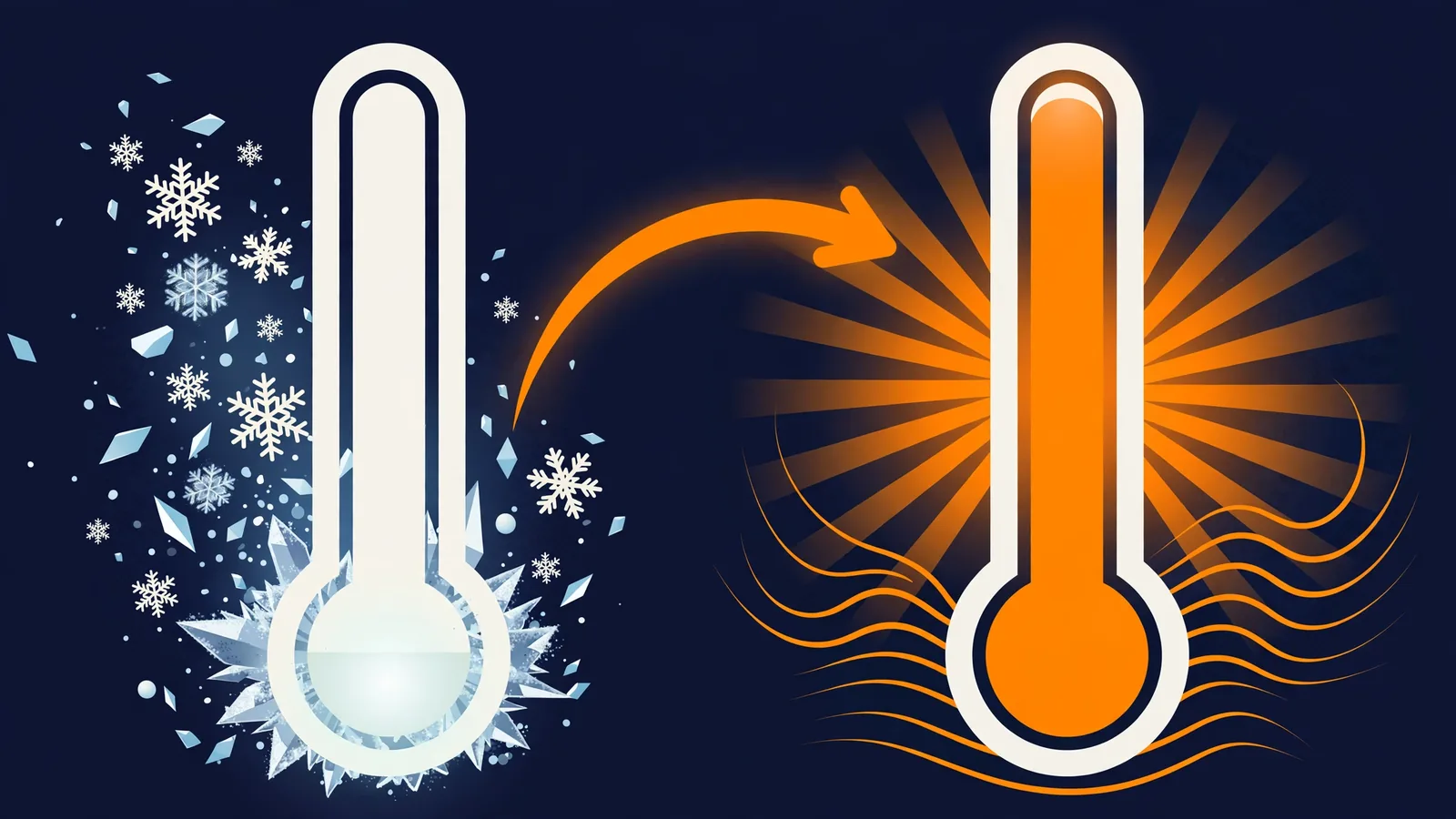
Instantly convert weather forecasts and recipes using our Temperature Converter, or read on to understand the complex formulas behind Celsius and Fahrenheit.
If an American travels to Europe and sees the weather forecast says "30 degrees," they might pack a heavy winter coat, expecting freezing weather. In reality, 30 degrees Celsius is a hot, sweltering summer day (86°F).
The United States is one of the only countries on Earth that still relies on the Fahrenheit scale for everyday temperature measurement. The rest of the world uses Celsius.
The History of the Scales
Why do the two scales exist, and why do they measure heat so differently?
Fahrenheit (1724)
Invented by physicist Daniel Gabriel Fahrenheit. He set 0 degrees as the freezing point of a specific brine solution (water, ice, and salt). He then set the average human body temperature around 96 degrees. (We now know body temperature is closer to 98.6°F). On this scale, pure water freezes at 32°F and boils at 212°F.
Celsius (1742)
Invented by astronomer Anders Celsius. He wanted a scale based entirely on the metric system (Base-10). He logically set the freezing point of pure water at exactly 0°C, and the boiling point of pure water at exactly 100°C.
Interestingly, Celsius originally designed his scale upside down, with 0 at boiling and 100 at freezing. After his death, the scale was flipped into the form we use today.
Why the United States Kept Fahrenheit
Most countries switched to Celsius as part of broader metric adoption during the 20th century. The United States began a voluntary metric transition in the 1970s, but everyday weather reporting never changed.
The result is a permanent translation problem. Americans abroad, and visitors to the US, convert temperatures constantly — which is why this skill stays useful.
There is one point where the argument ends, though. At −40 degrees, both scales read exactly the same number: −40°C equals −40°F.
Enter your own numbers and see the result instantly — free, no signup.
The Conversion Formulas
Because the two scales have completely different starting points (0 vs 32) and completely different increment sizes (there are 180 degrees between freezing and boiling in Fahrenheit, but only 100 degrees in Celsius), you cannot just add or subtract a flat number to convert between them.
You must use a formula involving fractions.
Converting Celsius to Fahrenheit
Formula: F = (C × 9/5) + 32
Example: Convert 20°C to Fahrenheit.
- Multiply by 9/5 (or 1.8):
20 × 1.8 = 36 - Add 32:
36 + 32 = 68Answer: 68°F
Converting Fahrenheit to Celsius
Formula: C = (F - 32) × 5/9
Example: Convert 100°F to Celsius.
- Subtract 32:
100 - 32 = 68 - Multiply by 5/9 (or divide by 1.8):
68 / 1.8 = 37.77Answer: 37.77°C
Why the Formula Has Two Parts
Each formula does two separate jobs. The multiplication fixes the different degree sizes between the scales.
The addition or subtraction of 32 fixes the different starting points. Skip either part and the answer is wrong, even though the arithmetic looks tidy.
This is also why there is no single "conversion factor" for temperature, unlike inches to centimeters. Temperature scales are offset, not just scaled.
If you convert often, bookmark the dedicated one-step tools for Fahrenheit to Celsius and Celsius to Fahrenheit alongside the main converter.
A Reference Table Worth Memorizing
A handful of anchor points covers most daily life. Learn these and you can estimate anything between them.
| Celsius | Fahrenheit | What it feels like |
|---|---|---|
| 0°C | 32°F | Water freezes |
| 10°C | 50°F | A cool spring day |
| 20°C | 68°F | Comfortable room temperature |
| 25°C | 77°F | A warm summer day |
| 30°C | 86°F | Hot — beach weather |
| 37°C | 98.6°F | Normal human body temperature |
| 100°C | 212°F | Water boils (at sea level) |
Notice the pattern in the weather rows: every 5°C step equals exactly 9°F. That rhythm makes mental interpolation between anchors much easier.
Travelers often memorize just three anchors: 0, 20, and 30. Those cover freezing, room comfort, and summer heat — the three judgments you actually make when packing a suitcase or reading a forecast abroad.
Converting Oven Temperatures for Recipes
Recipes cause the most practical conversion headaches. A British cookbook's 180°C is not a gentle heat in Fahrenheit terms.
Worked example: 180 × 1.8 = 324, then 324 + 32 = 356. So 180°C equals 356°F, which is why American recipes round it to a 350°F oven.
Many UK recipes also use Gas Mark. Gas Mark 4 corresponds to 180°C (350°F), a standard moderate oven for cakes and roasts.
A useful baking shortcut: for common settings, 160°C ≈ 325°F, 180°C ≈ 350°F, 200°C ≈ 400°F, and 220°C ≈ 425°F. Each is rounded to the nearest standard oven dial setting.
Mental Math Shortcuts
Doing complex fractional math in your head is difficult. If you are traveling and just need a rough estimate, use these mental shortcuts:
Quick C to F: Double the Celsius number, then add 30. Example: 20°C. Double it (40) + 30 = 70°F. (Actual is 68°F. Very close!)
Quick F to C: Subtract 30 from the Fahrenheit number, then cut it in half. Example: 80°F. Subtract 30 (50) and cut in half = 25°C. (Actual is 26.6°C).
Know the Shortcut's Limits
These tricks are tuned for mild weather, where their error is only a degree or two. The error grows as temperatures move away from room temperature.
At 30°C, "double and add 30" gives 90°F, but the true answer is 86°F — a 4-degree error. Fine for choosing a jacket; not fine for an oven or a fever.
For a fever check, always convert exactly. A reading of 39°C converts to 102.2°F, and rounding that down casually loses information that matters.
Converting Negative Temperatures
Winter weather brings negative numbers, and they follow the same formulas. The only trap is sign carelessness.
Worked example: convert −10°C to Fahrenheit. Multiply first: −10 × 1.8 = −18. Then add 32: −18 + 32 = 14. So −10°C equals 14°F — cold, but not extreme.
Going the other way, 0°F converts as (0 − 32) ÷ 1.8 = −17.8°C. Notice that 0°F is well below freezing, even though zero sounds harmless.
This surprises many visitors to cold US regions. A forecast of "5 degrees" in Chicago means 5°F, which is −15°C — serious winter gear territory.
Does Water Always Boil at 100°C?
Only at standard sea-level air pressure. Boiling happens when water vapor pressure matches the surrounding air pressure, so elevation changes the answer.
In Denver, about a mile above sea level, water boils at roughly 95°C (about 203°F). On high mountain peaks it boils cooler still.
This is why mountain recipes add cooking time: boiling water there is simply not as hot. The conversion formulas stay the same; the reference points shift.
Fahrenheit's 212°F boiling point carries the same fine print. Both scales quietly assume you are standing near sea level.
Common Conversion Mistakes
- Forgetting the 32. Multiplying by 1.8 alone converts the size of the degree, not the scale. The offset is not optional.
- Applying the steps backwards. For Fahrenheit to Celsius, subtract 32 first, then multiply. Reversing the order gives a badly wrong answer.
- Rounding mid-calculation. Convert with the full formula, then round the final answer to the precision you need.
- Trusting the shortcut at extremes. Oven, fever, and scientific temperatures deserve the exact formula every time.
FAQ
What is the Kelvin scale?
Kelvin is a scientific temperature scale used in physics and astronomy. Unlike Fahrenheit and Celsius, Kelvin has no negative numbers. It starts at "Absolute Zero" (0 K), which is the theoretical point where all molecular movement completely stops. It uses the exact same increment size as Celsius, but starts much lower. 0 K = -273.15°C.
At what temperature are Fahrenheit and Celsius equal? At −40. Solving the conversion formula against itself gives −40°C = −40°F, the single crossover point of the two scales. It is a handy sanity check for your arithmetic.
How do I convert Celsius to Kelvin? Just add 273.15. Room temperature of 25°C becomes 298.15 K. No multiplication is needed, because Kelvin and Celsius degrees are exactly the same size.
Why do Celsius thermostats often use half-degree steps? Because a Celsius degree is larger — exactly 1.8 times a Fahrenheit degree. A whole-degree jump in Celsius can feel abrupt, so many Celsius thermostats adjust in 0.5°C steps. Fahrenheit thermostats get similar fine control from whole degrees alone, since each step is smaller.
Why does body temperature read 98.6°F but 37°C exactly?
Because 37°C was the rounded Celsius estimate adopted historically, and 98.6°F is simply its exact conversion: 37 × 1.8 + 32 = 98.6. Healthy body temperature actually varies a little by person and time of day.
Don't ruin a recipe by guessing the oven temperature. Get precise scientific conversions instantly using the CalcUnit Temperature Converter.